

TL;DR: A practical home safety checklist for seniors is the foundation of aging in place. This room-by-room guide covers grab bars, lighting, loose rugs, bathroom safety, stairs, and medication management, plus the Maryland programs that can help pay for modifications. The honest truth: even a perfectly modified home has gaps that hardware can’t fill, which is where in-home support keeps a parent safe over the long run.
Why start with a home safety checklist for seniors?
Because falls are the single biggest threat to staying home safely. A home safety checklist for seniors lets you find and fix hazards before they cause an injury, rather than after. According to the U.S. Centers for Disease Control and Prevention, about 1 in 4 adults age 65 and older falls each year, and falls are the leading cause of injury-related death in that age group. The encouraging part is that most falls are predictable and preventable, and the fixes are often inexpensive.
If you are an adult child in Prince George’s, Montgomery, Howard, Anne Arundel, or Charles County trying to help a parent stay in the home they love, this is the right place to begin. Walk through the house together, then use the aging in place tips below room by room.
- Key takeaways: Most falls happen in the bathroom, on stairs, and around loose rugs.
- The cheapest, highest-impact fixes are grab bars, brighter lighting, and removing trip hazards.
- Maryland offers real help paying for home modifications through Area Agencies on Aging and Medicaid.
- Home modifications work best paired with in-home support for the tasks that get harder over time.
What are the most important home modifications for an elderly parent?
Focus first on the entryway, the bathroom, and the stairs, the three places where serious falls cluster. These home modifications for an elderly parent deliver the most safety per dollar and can usually be installed in an afternoon.
- Entryways: Add a sturdy railing to porch steps, install a threshold ramp for a raised doorsill, and put a bench near the door for setting bags down and steadying balance.
- Lighting: Replace dim bulbs with brighter LEDs, add motion-sensor night lights in hallways and bathrooms, and place a lamp within arm’s reach of the bed.
- Flooring: Remove or double-side-tape loose throw rugs, secure carpet edges, and clear cords and clutter from walking paths.
- Reach and grip: Move everyday items to waist height to eliminate step stools, and replace round doorknobs with lever handles that arthritic hands can use.
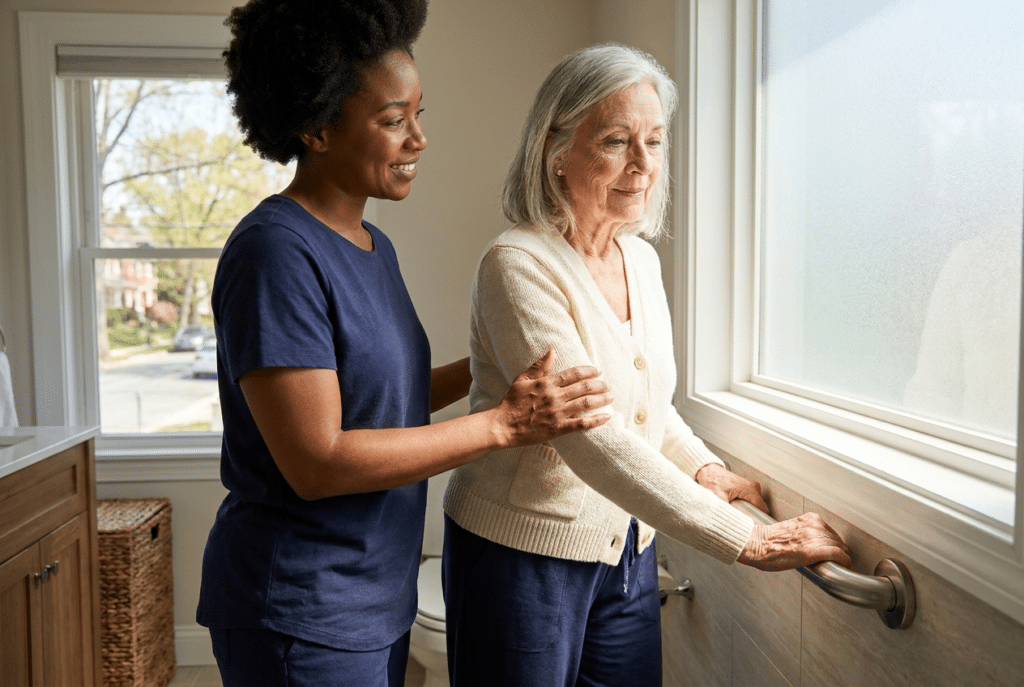
What does a room-by-room home safety checklist for seniors look like?
Fall prevention for elderly at home works best when you go space by space. Use the table below as your printable walkthrough, checking off each item and noting anything that needs professional installation.
| Room | What to check | Priority fix |
|---|---|---|
| Bathroom | Wet floors, tub entry, low toilet, no grab bars | Install grab bars by toilet and in shower; add a non-slip mat and shower chair |
| Stairs | Loose or single railing, poor lighting, no edge contrast | Add railings on both sides; mark step edges with contrasting tape; light top and bottom |
| Bedroom | Dark path to bathroom, bed too high or low, clutter | Motion night lights; clear path; phone and lamp within reach |
| Kitchen | High shelves, step stools, slippery floors | Relocate daily items to waist height; add non-slip mats at sink |
| Living areas | Throw rugs, cords, low soft chairs | Remove rugs; tape down cords; add firm chairs with armrests |
| Whole home | Smoke and CO alarms, emergency contacts, medications | Test alarms; post contacts; set up a personal emergency response system |
Which bathroom items belong on a home safety checklist for seniors?
Bathroom safety for seniors starts with grab bars and traction, because wet, hard surfaces are where the worst falls happen. The bathroom is the highest-risk room in the house, so it deserves the most attention.
- Mount professionally anchored grab bars beside the toilet and inside the shower or tub. Never rely on a towel bar or suction cup as a substitute.
- Add a shower chair or transfer bench and a handheld shower head so bathing can happen seated.
- Use non-slip mats inside and outside the tub, and consider a raised toilet seat to reduce strain on hips and knees.
- Set the water heater to 120 degrees Fahrenheit to prevent scald injuries, which are common when reflexes slow.
How should we handle medications and everyday safety?
Medication management belongs on every safety plan, because missed or doubled doses cause dizziness, confusion, and falls. Simple systems prevent most errors.
- Use a weekly pill organizer or an automatic dispenser, and keep an up-to-date medication list on the refrigerator.
- Review all prescriptions with a pharmacist once a year to catch interactions and drugs that increase fall risk.
- Enroll a parent who lives alone in Maryland’s free Senior Call Check and Social Connections Program, which places a daily automated wellness call to residents age 60 and older.
- Keep a charged phone, emergency contacts, and a personal emergency response pendant within easy reach.
Where do home modifications stop and in-home care begin?
Grab bars and brighter lights make a home safer, but they cannot help someone in and out of the shower, notice a change in balance, or prepare a meal on a hard day. That is the gap in-home support fills, and it is why the strongest aging in place plans combine hardware with hands-on help.
As tasks get harder over time, families in Maryland typically layer in one or more services. Personal care assists with bathing, dressing, and mobility, exactly the moments when bathroom falls occur. Companion care provides supervision and social connection for a parent who should not be alone all day. Homemaker services keep floors clear, laundry done, and meals cooked, removing the very hazards your checklist just addressed. You can see how these fit together on the Vanguard home care hub.
Are there Maryland programs to help pay for home modifications?
Yes. Maryland offers several paths to help cover modifications and in-home support, so cost does not have to stall a safety plan. Start with your county’s Area Agency on Aging, then explore Medicaid if income-eligible.
- Area Agencies on Aging: Through the Maryland Department of Aging, local agencies can arrange minor home repairs, home modifications, chore help, and emergency response systems. Each of Vanguard’s counties, including Montgomery, Prince George’s, Howard, Anne Arundel, and Charles, has its own agency.
- Community First Choice (Medicaid): For those who qualify medically and financially, Maryland’s Medicaid Community First Choice program can cover home modifications, assistive technology, personal emergency response systems, and personal care assistance.
- Veterans benefits: Eligible veterans and surviving spouses may access grants and the Aid and Attendance pension to offset modification and care costs.
For a plain-language breakdown of what care costs in our area and how to fund it, see our Maryland home care cost guide and paying for home care resources. You can also confirm we serve your area on the service areas page.
Ready to turn your home safety checklist for seniors into a real safety plan? Call Vanguard Care Solutions at 301-327-1444 or request your free in-home consultation. Our RN-supervised, dementia-trained team will walk the home with you, flag hazards, and recommend the right level of support, with no pressure and no cost to start.
Frequently asked questions
What is the single most effective home modification for fall prevention?
Professionally installed grab bars in the bathroom are the highest-impact fix, because the bathroom is the most common site of serious falls. Pair them with brighter lighting and the removal of loose throw rugs for the biggest safety gain at the lowest cost.
How do I help my parents age in place if they resist the idea of care?
Start with the home, not the person. Framing changes as making the house safer feels less threatening than saying a parent needs help. Begin with a checklist walkthrough together, add modifications, then introduce companion or homemaker support as a way to keep them independent rather than a loss of control.
Does Medicare pay for home modifications like grab bars in Maryland?
Original Medicare generally does not cover home modifications or non-medical in-home care. Some Medicare Advantage plans offer limited home-safety benefits, and Maryland Medicaid’s Community First Choice program can cover modifications for those who qualify. Your county Area Agency on Aging can help you find funding.
How often should we review the home for new safety hazards?
Review the home at least once a year and any time your parent’s health changes, such as after a hospital stay, a new diagnosis, a medication change, or a fall. Needs evolve, so a home that was safe last year may need new adjustments now.
Which Maryland counties does Vanguard Care Solutions serve?
Vanguard provides non-medical in-home senior care across Prince George’s, Montgomery, Howard, Anne Arundel, and Charles counties. As a licensed Maryland Residential Service Agency with RN-supervised, dementia-trained caregivers, we offer a complimentary first consultation to families anywhere in our service area.