

TL;DR: Dementia wandering prevention at home comes down to four things: understand why wandering and sundowning happen, secure the home room by room, build a calming late-afternoon routine, and know exactly what to do in the first 15 minutes if your loved one goes missing. Below is a practical, Maryland-specific safety guide, plus how trained, RN-supervised supervision fits in as your safety net.
Key takeaways
- About 6 in 10 people living with dementia will wander at some point, according to the Alzheimer’s Association — so plan for it before it happens.
- Most wandering is purposeful: your loved one is trying to get somewhere or meet a need, not simply “acting out.”
- Sundowning (late-day agitation) responds best to routine, light, and a calm environment — not to arguing or over-stimulation.
- If a loved one goes missing, search a roughly 1.5-mile radius and call 911 within about 15 minutes.
- Trained supervision is the strongest safeguard when a parent can no longer be left alone safely.
Why do people with dementia wander?
People with dementia wander because a need or memory is driving them somewhere — the brain is trying to solve a problem the disease has scrambled. Effective dementia wandering prevention at home starts with recognizing that wandering is rarely random. Your parent may be searching for a bathroom, looking for a spouse or a childhood home, trying to “go to work,” escaping noise or discomfort, or simply burning off restless energy. When you can spot the trigger, you can often redirect the behavior before it reaches the front door.
Common triggers to watch for in a Maryland home:
- Unmet needs: hunger, thirst, needing the bathroom, pain, or feeling too hot or cold.
- Disorientation: waking in an unfamiliar room, or after a move or hospital stay.
- Old routines: a lifelong 5 p.m. commute or school pickup that still feels urgent.
- Over- or under-stimulation: a loud, crowded room, or long stretches of boredom.
What is sundowning and how do you manage it?
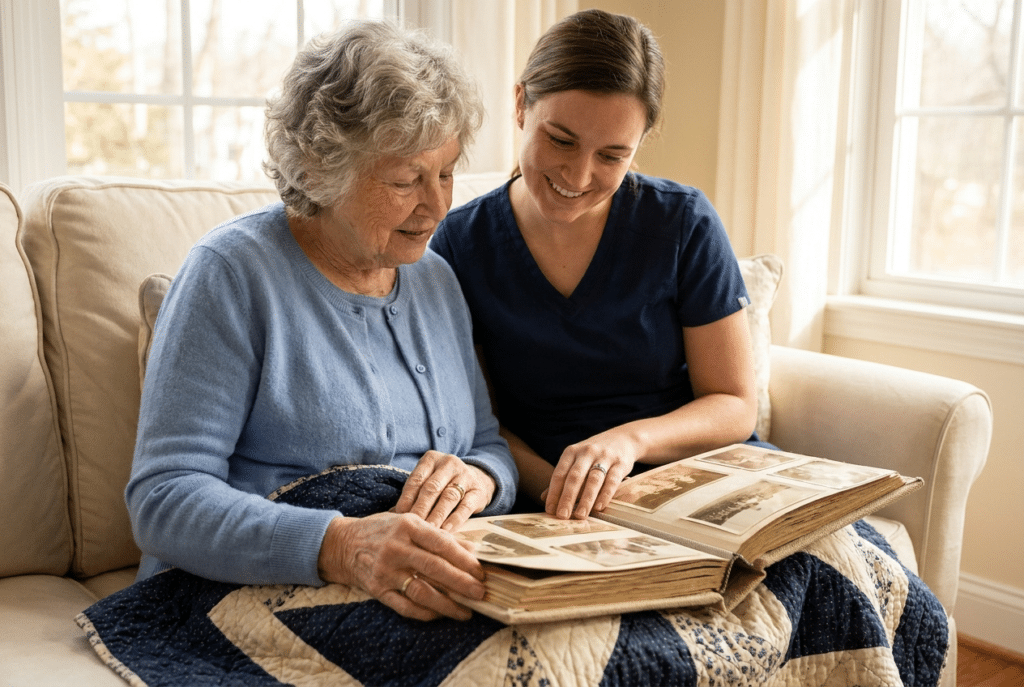
Sundowning is a pattern of increased confusion, restlessness, and agitation that appears in the late afternoon and evening for some people with dementia. As natural light fades, fatigue, hunger, and a full day of mental effort combine, and your loved one can become anxious, suspicious, or determined to leave. The goal isn’t to argue them out of it — it’s to lower the temperature of the whole environment before the storm builds.
A calming late-afternoon routine that many families and our dementia and Alzheimer’s care team rely on:
- Turn on lights before dusk. Close blinds to erase confusing shadows and reflections that can look like intruders.
- Front-load the day. Schedule appointments, baths, and outings in the morning when your parent is freshest.
- Offer a light snack and hydration around 4–5 p.m.; hunger and thirst worsen agitation.
- Cut afternoon caffeine and limit long naps so nighttime sleep comes easier.
- Shift to quiet, familiar comfort: soft music, folding towels, a favorite show, or a slow walk.
- Stay calm and validate feelings. “I can see you’re worried — I’m right here” works better than correcting them.
Room-by-room dementia wandering prevention at home: a safety checklist
The most effective home safety plan combines securing exits with removing the everyday hazards a confused person can’t reliably judge. Walk your parent’s home with fresh eyes and work through it room by room.
| Area | Key safety steps |
|---|---|
| Exits & front door | Add a slide-bolt or deadbolt out of the usual line of sight (high or low on the frame); install door/window alarms or chimes; consider a GPS locator or the local “Project Lifeline”-style tracking program. |
| Kitchen | Use stove knob covers or an auto shut-off; lock up sharp objects, cleaners, and medications; unplug small appliances when not in use. |
| Bathroom | Grab bars, non-slip mats, a raised toilet seat, and a night light; set the water heater below 120°F to prevent scald burns. |
| Bedroom & halls | Motion-activated night lights along the path to the bathroom; a bed alarm; remove throw rugs and clutter that cause falls. |
| Stairs & outdoors | Gates at stairs; secure fences and gates; remove ice, hoses, and tripping hazards from Maryland porches and walkways. |
One more essential: enroll your loved one in a wandering-response program and keep a current photo and clothing description handy. The Alzheimer’s Association offers guidance and 24/7 support, and many Maryland police departments participate in vulnerable-adult registries and locator programs.
Is it safe to leave a dementia patient home alone?
Sometimes yes in the earliest stage, but once wandering, appliance mishaps, or confusion about time and place begin, the answer is generally no. The safest approach is to match supervision to the stage rather than guess. Use this quick guide as a starting point.
| Stage / signs | Alone safely? | Typical support |
|---|---|---|
| Early: mild forgetfulness, no wandering | Short, planned periods with check-ins | Companion visits, personal care a few hours a week |
| Middle: wandering, sundowning, leaves stove on | Not for long; needs supervision | Daily hours plus respite care for family |
| Later: exit-seeking, up at night, high fall risk | No — needs continuous supervision | 24-hour or live-in care |
Every Vanguard care plan begins with a registered-nurse assessment, so you get an objective read on exactly how much supervision your parent needs — no more, no less.
What should you do if a dementia patient goes missing?
Act immediately — the first 15 minutes matter most. Do not wait or assume they’ll come back. Following established Alzheimer’s Association guidance, move fast and systematically:
- Search the home and yard first — closets, vehicles, the basement, behind doors — since people are often found close by.
- Search the immediate neighborhood within about a 1.5-mile radius. People with dementia often travel in the direction of their dominant hand and head toward familiar or former destinations (an old home, a church, a workplace).
- If you haven’t found them in roughly 15 minutes, call 911. Say clearly that the person has dementia or Alzheimer’s and is a “vulnerable” or “endangered” adult, which speeds the response.
- Give responders a recent photo, today’s clothing description, and any GPS or medical details. Note nearby water, busy roads, or wooded areas common across Maryland counties.
Prevention, of course, beats any search: a trained caregiver who recognizes pre-wandering restlessness and redirects it is the reason most exits never happen.
How does dementia wandering prevention at home work with professional care?
Trained supervision is the safety net that turns all of these strategies into reliable, day-in-day-out protection. Family caregivers get tired; a person with dementia does not keep a schedule. At Vanguard Care Solutions, every caregiver is dementia and memory-care trained, and select caregivers hold the Alzheimer’s Association essentiALZ certification — which means they’re taught to read the early signs of agitation, ease sundowning, and safely redirect wandering before it becomes an emergency. We serve families across Prince George’s, Montgomery, Howard, Anne Arundel, and Charles counties, and you can confirm coverage in your town on our Maryland service areas page.
Worried about wandering or sundowning at home? Call Vanguard Care Solutions at 301-327-1444 or request your free, RN-guided consultation today. We’ll build a safety-focused dementia care plan tailored to your parent and your Maryland county — with trained caregivers who keep watch so your family can finally rest.
Frequently asked questions
Is it safe to leave a dementia patient home alone?
It depends on the stage. In very early dementia, short, planned periods alone may be fine with safeguards like a checked-in phone and a locked stove. Once a person begins wandering, gets confused about time or place, leaves appliances on, or can no longer respond safely in an emergency, it is not safe to leave them alone. At that point most Maryland families arrange scheduled visits, overnight coverage, or 24-hour supervision. A quick RN assessment can tell you exactly where your parent falls on that spectrum.
How do I stop a dementia patient from wandering at night?
Nighttime wandering usually eases when you reduce daytime napping, add gentle afternoon activity and light exposure, limit caffeine and fluids in the evening, and make sure your loved one uses the bathroom right before bed. Use motion-activated night lights along the path to the bathroom, a bed or door alarm, and secured exits. If the person is regularly up and trying to leave overnight, overnight or live-in care keeps them safe without exhausting the family caregiver.
What is sundowning and how long does it last?
Sundowning is a pattern of increased confusion, restlessness, anxiety, or agitation that appears in the late afternoon and evening in some people with dementia. Episodes commonly last from the late afternoon into the evening and may continue for a few hours. For many people it is worse in the middle stages of dementia and tends to lessen as the disease progresses. A consistent daily routine and a calm, well-lit late-day environment are the most effective ways to reduce it.
What should I do first if my parent with dementia goes missing?
Act immediately. Quickly check the home and yard, then search the immediate area, focusing on a roughly 1.5-mile radius and in the direction of your loved one’s dominant hand and any familiar or former destinations. If you do not find them within about 15 minutes, call 911. Tell the dispatcher the person has dementia or Alzheimer’s and is a vulnerable adult, and have a recent photo and a description of their clothing ready.
Does Vanguard provide dementia-trained caregivers in my Maryland county?
Yes. Vanguard Care Solutions serves Prince George’s, Montgomery, Howard, Anne Arundel, and Charles counties, and every caregiver is dementia and memory-care trained, with select caregivers holding the Alzheimer’s Association essentiALZ certification. Every care plan is supervised by a registered nurse. Call 301-327-1444 for a complimentary consultation to build a safety-focused plan for your loved one.